%27%3E%3Crect%20x=%27-35%27%20y=%27-26%27%20width=%2770%27%20height=%2752%27%20rx=%2713%27%20fill=%27%2364BA5D%27/%3E%3Cpath%20d=%27M-10%2024l0%2016l16%20-16z%27%20fill=%27%2364BA5D%27/%3E%3Cg%20fill=%27%23fff%27%3E%3Cellipse%20cx=%270%27%20cy=%277%27%20rx=%2712%27%20ry=%2710%27/%3E%3Cellipse%20cx=%27-13%27%20cy=%27-8%27%20rx=%275%27%20ry=%276.5%27/%3E%3Cellipse%20cx=%27-5%27%20cy=%27-15%27%20rx=%275%27%20ry=%276.5%27/%3E%3Cellipse%20cx=%275%27%20cy=%27-15%27%20rx=%275%27%20ry=%276.5%27/%3E%3Cellipse%20cx=%2713%27%20cy=%27-8%27%20rx=%275%27%20ry=%276.5%27/%3E%3C/g%3E%3C/g%3E%3Cpath%20id=%27b%27%20d=%27M58%20100a42%2042%200%200%200%2084%200%27%20fill=%27none%27/%3E%3Ctext%20font-family=%27Arial,Helvetica,sans-serif%27%20font-weight=%27bold%27%20font-size=%2711%27%20fill=%27%2364BA5D%27%20letter-spacing=%272.5%27%3E%3CtextPath%20href=%27%23b%27%20startOffset=%2750%25%27%20text-anchor=%27middle%27%3EHEALERS%20PET%20CARE%3C/textPath%3E%3C/text%3E%3C/svg%3E)

Travel and Car Anxiety: Crate, Restraint, and Motion Strategies
Travel and Car Anxiety: Crate, Restraint, and Motion Strategies
Travel and car anxiety can turn necessary rides into high-stress events. Many dogs struggle with confinement, restraint, or the motion itself. These triggers often stack, amplifying arousal and nausea.
This guide focuses on practical steps you can apply now. You will learn how to choose a setup, run a two‑week desensitization plan, screen for motion sickness, and pack smarter for calmer trips.
Why some dogs struggle in cars (and how to pick the right setup)
Identify the primary trigger: confinement, restraint, or motion
Observe when tension rises. If stress spikes before movement, confinement or restraint may be the main factor. If anxiety escalates with acceleration, turns, or stops, motion likely plays a leading role. Some dogs show dog car anxiety from layered triggers: tight quarters, inconsistent footing, and noise. Clarifying the primary driver helps you select the best-starting environment and training focus. Evidence suggests targeted behavior plans improve outcomes for travel stress and related anxieties.[4]
Choose a starting environment: crate, seat-belt harness, or booster
Match the setup to the trigger. A dog crate for car travel can reduce visual motion and provide predictable boundaries if confinement lowers arousal. A dog seat belt restraint suits dogs who dislike crates but tolerate stable torso support. Small dogs may benefit from a booster to raise sightlines and stabilize posture. Start with the option your dog accepts most readily, then build calm through gradual exposure.
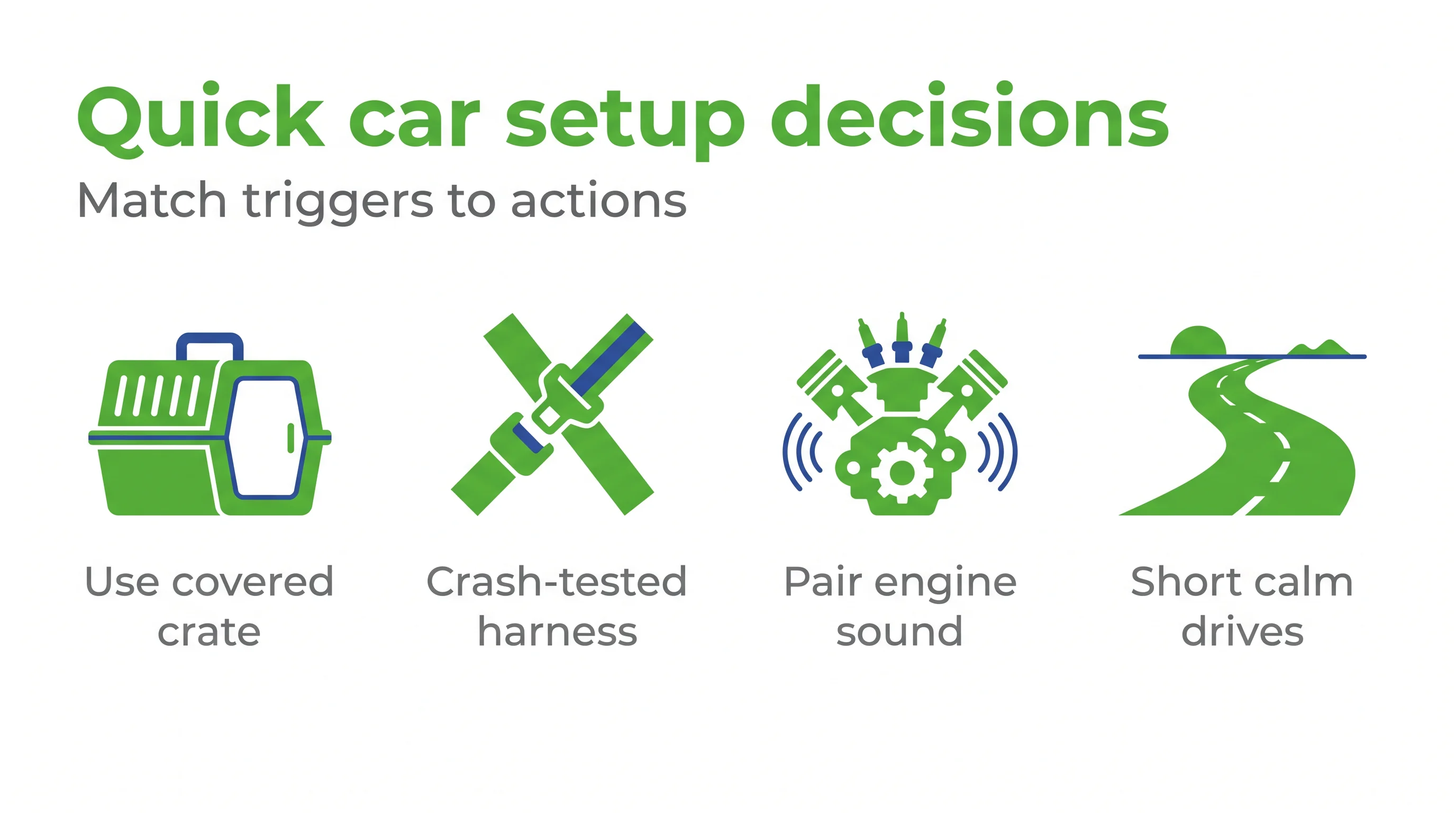
Quick decision guide: match scenarios to actions
If X situation, then Y action (5–7 common cases)
- If your dog refuses to enter the car, then train approach-and-reward at the garage threshold, not inside the vehicle yet.
- If your dog panics in a crate, then try a crash-tested harness with a short tether and cover side windows to reduce visual flow.
- If your dog drools during movement, then test very short drives on smooth routes and evaluate for canine motion sickness.
- If whining begins with engine start, then conduct engine-on sessions without driving, pairing with a high-value chew.
- If pacing continues with a harness, then test a snug, ventilated crate positioned low to reduce sway and braking forces.
- If your small dog braces and shivers, then try a booster with chest-and-hip stabilization to reduce fore-aft sliding.
- If improvement stalls after a week, then reduce session intensity and add recovery days before increasing complexity again.
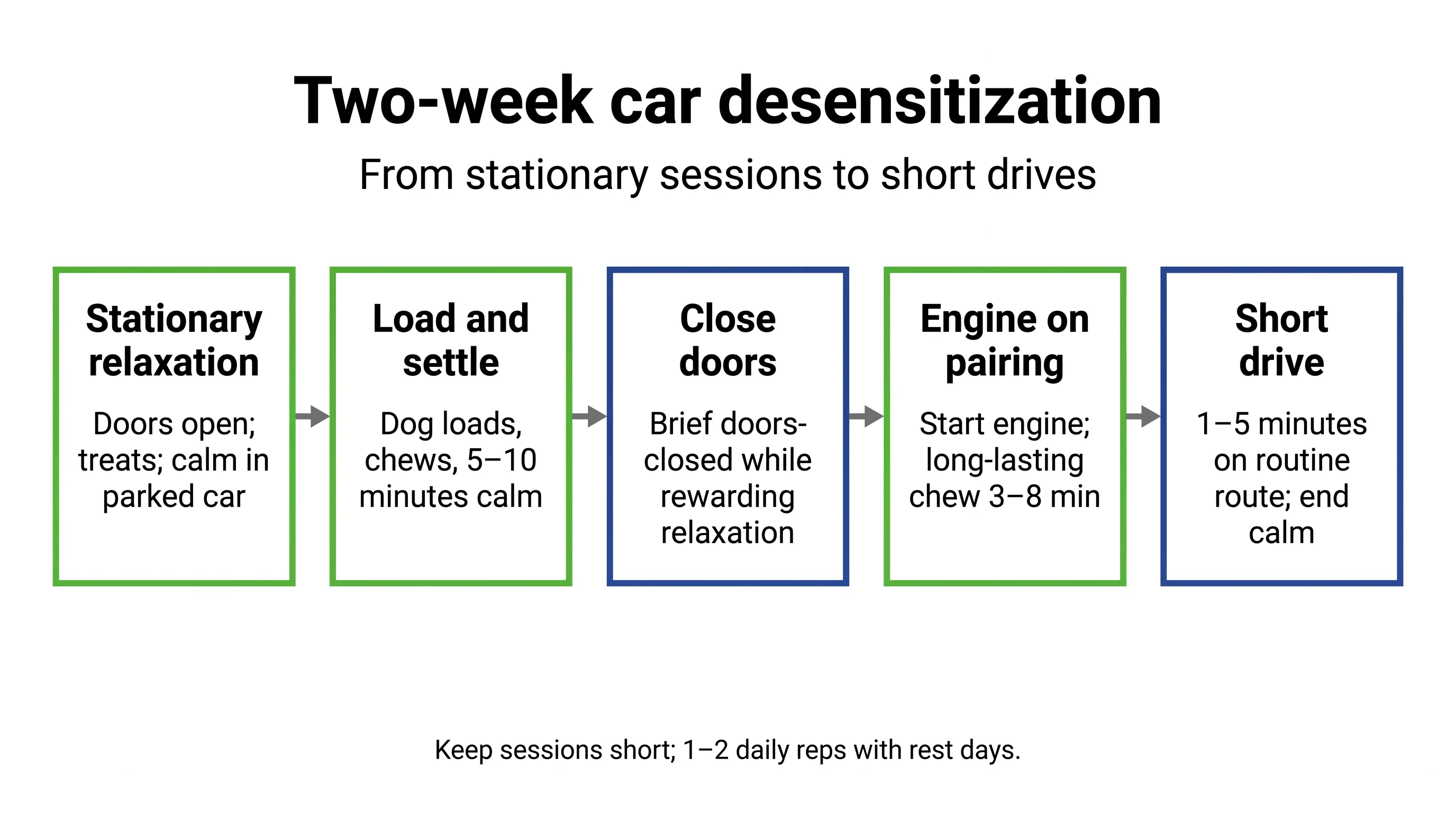
Stepwise car desensitization protocol (two weeks to start)
Days 1–3: parked-car calm
Run 5–10 minute sessions in a stationary car with doors open for airflow. Feed a chew or scatter treats to build positive association. Practice loading and unloading with a release cue. If gentle pressure reduces arousal, a calming wrap may assist pairing calm with the space; many pet owners find Healers Therapeutic & Anxiety Front Body Wrap helpful for this task. End each session before stress appears, and add breaks between repetitions.
Days 4–7: engine-on pairing
Close doors, start the engine, and deliver a long-lasting chew for 3–8 minutes. Keep windows cracked for fresh air. Practice 1–2 repetitions per day, then release and exit. If your dog remains settled, briefly move the car several feet within the driveway. Maintain low intensity to preserve confidence. Desensitization and counterconditioning work best when stress remains sub-threshold.[4]
Week 2: micro-drives and recovery days
Run two to four micro-drives of 1–3 minutes on smooth, quiet roads. Use gentle accelerations and wide turns. Include at least two recovery days with only parked-car sessions. Gradually extend drives by 1–2 minutes when your dog meets calm criteria: steady breathing, soft posture, and engagement with a chew. If signs regress, shorten distance and simplify the environment. Transport stress appears modifiable with training and thoughtful planning.[3]
Restraint and crate selection: safety-first fit checks
Crate sizing, placement, and ventilation
Choose a crate that allows standing, turning, and lying comfortably, with roughly 2–4 inches of head clearance. Place it on the vehicle floor or cargo area against a seatback to reduce motion transfer. Anchor to tie-down points to prevent sliding. Ensure ventilation on at least three sides and shade from direct sun. Use a non-slip mat and a light cover on the side facing windows to reduce visual motion. Avoid unsecured or stacked crates.
Harness and tether length for stable positioning
Select a crash-tested harness with wide chest panels and metal hardware. Attach to the seat-belt system or cargo anchor. A short tether, often 6–12 inches, helps prevent forward launch while allowing comfortable posture. Clip to the back D-ring, not a collar. Position your dog on a rear seat or cargo area, never in a front seat with airbags. For dogs sensitive to pressure, test fit indoors first and pair with rewards.
Motion-sickness checklist: rule-in/rule-out
Early signs to watch for
Monitor for drooling, lip-licking, frequent swallowing, yawning, and restlessness that increase with vehicle motion. Nausea can precede vomiting. Some dogs with travel and car anxiety show anticipatory stress, while others display signs only during movement. A vet consultation can confirm motion sickness and discuss antiemetic options. Emerging data also suggest some nutraceuticals, including CBD, may reduce stress linked to car travel in certain dogs.[2]
Diet timing, airflow, and route planning
Offer a light meal 3–4 hours before travel and maintain water access. Use cool airflow directed toward your dog, with windows slightly open to equalize pressure. Route choices matter: pick smoother roads, fewer hills, and wider turns. Seat orientation that reduces lateral movement helps. Keep cleanup supplies, including a gentle HOCl wound cleanser, for safe skin care after messes. If vomiting persists, reduce duration and consult your veterinarian.
Monitoring progress: what to track at 7–14 days and 4–8 weeks
Short-term markers of improvement
By days 7–14, look for faster approach to the vehicle, calmer loading, and earlier engagement with food or a chew. Track session duration without stress signals and the ability to maintain a relaxed down. Note any reduction in drooling and panting during micro-drives. Consistency across two to three sessions typically indicates readiness to progress.
Longer-term stabilization and when to adjust
At 4–8 weeks, target predictable calm for 15–30 minute drives on routine routes. Your dog should settle within minutes and remain engaged with a chew. If setbacks occur, step back one phase and add rest days. For persistent difficulty entering the car or ongoing nausea, re-evaluate equipment fit, route smoothness, and training pace. Consider adjunct calming aids with your veterinary team’s guidance.[4]
Practical safety boundaries you should not cross
Vehicle safety and product use limits
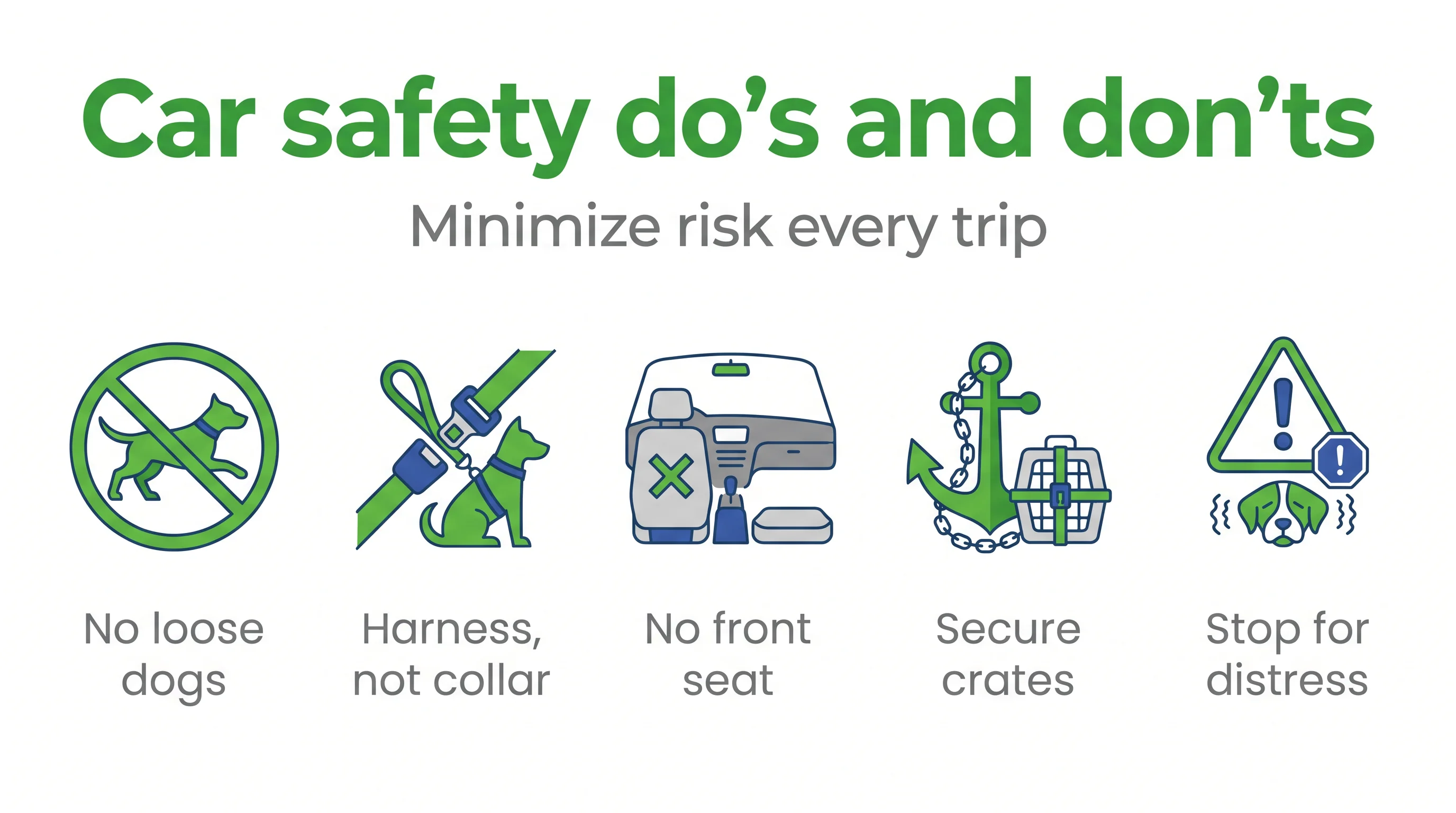
Never travel with a loose dog. Avoid attaching tethers to collars. Do not place your dog in the front seat with active airbags. Secure crates to fixed points and follow manufacturer instructions. Replace gear after accidents or visible damage. Avoid long drives in extreme heat or without ventilation. Do not stack cargo around your dog that could shift or block airflow.
When to stop a session and reset
Stop if your dog shows escalating distress: frantic panting, escape attempts, vocalizing, or refusal to take food. Shorten sessions next time and return to an easier step. If vomiting or diarrhea occurs repeatedly, pause the plan and contact your veterinarian. Brief resets protect confidence and preserve training momentum more reliably than pushing through.
Evidence status: what research and expert guidance suggest
Desensitization and counterconditioning
Behavioral programs using gradual exposure and positive pairing are widely recommended for anxiety contexts, including car travel. They aim to build new, calm associations while avoiding stress spikes. Reviews of canine anxiety note that targeted plans and structured management often improve outcomes when tailored to the dog’s triggers and environment.[4]
Restraint safety standards and motion aid options
Transport research highlights welfare risks from inadequate restraint and poor planning, suggesting training and secure containment improve comfort and safety.[3] Early studies also report that cannabidiol (CBD) may reduce physiological stress responses during car travel in some dogs, both as a single dose and with daily use, though veterinary guidance is essential.[2][1]
Packing checklist for calmer trips
Before you leave
- Fitted crate or harness with tether, plus non-slip mat and cover.
- High-value chews, measured treats, and a water bowl with fresh water.
- Extra leash, waste bags, seat or crate liners, and absorbent towels.
- Medical records, medications, and vet contact information.
- Window shades and a portable fan if heat or sun exposure is possible.
In the car
- Secure crate or harness check before ignition, and again at rest stops.
- Chew or food puzzle deployed only when the car is stationary, then reevaluate.
- Cool airflow and predictable music or white noise to mask traffic sounds.
- Non-spill water bowl and a clean-up kit for motion-related messes.
At rest stops
- Leash before doors open; confirm ID tags and microchip details are current.
- Potty on safe surfaces away from traffic; reward calm returns to the car.
- Offer water, reassess gear fit, and provide a short sniff break for decompression.
Where this fits in your broader anxiety plan
Linking to the main anxiety orientation hub
Car work integrates with home routines, calm-on-cue practice, and general decompression. For a strategic view of triggers, routines, and supportive tools, visit our main anxiety orientation hub. If your plan involves body-pressure tools or supplements, explore balanced approaches in Natural Calming Aids and Body Wraps: What Helps and When. Crate comfort outside of travel also matters; see Crate and Alone‑Time Training for Working Households. For recovery contexts that may overlap with travel, review Post‑Injury or Post‑Surgery Anxiety: Comfort Without the Cone.
Frequently Asked Questions
Is a crate or a seat-belt harness better for dogs with car anxiety?
It depends on your dog’s trigger. If confinement lowers arousal, a properly sized, well-ventilated crate may help. If confinement increases stress, a crash-tested harness with a short tether that stabilizes the torso may be more comfortable.
How long does car desensitization usually take?
Early progress may appear within 1–2 weeks, but building durable calm can take 4–8 weeks. Short, predictable sessions with rest days tend to improve outcomes.
How can I tell if my dog has motion sickness versus anxiety?
Motion sickness often includes drooling, lip-licking, swallowing, and nausea that track with movement. Anxiety may start before the car moves and include pacing, vocalizing, or refusal to enter the vehicle. Some dogs have both.
Should my dog eat before a car ride?
For dogs prone to nausea, many vets suggest a light meal 3–4 hours before travel and access to water. Individual tolerance varies, so observe and adjust timing accordingly.
Where should I place a crate in the car?
A crate is often placed on the vehicle floor or cargo area against the seatback to limit motion, secured to tie-down points. Ensure airflow, shade from direct sun, and that crumple zones are considered per your vehicle’s layout.
Car desensitization, safe restraint, and motion management work together. Start with the lowest-stress environment, progress in small steps, and track outcomes weekly. With measured practice and good safety habits, most dogs gain comfort and confidence on the road.
References
- HE Flint et al. (2024). Daily dosing of cannabidiol (CBD) demonstrates a positive effect on measures of stress in dogs during repeated exposure to car travel. Journal of Animal …. View article
- ABG Hunt et al. (2023). A single dose of cannabidiol (CBD) positively influences measures of stress in dogs during separation and car travel. Frontiers in veterinary …. View article
- A Tateo et al. (2022). The welfare of dogs and cats during transport in Europe: A literature review. Italian Journal of Animal …. View article
- G Lodrini et al. (2025). A Comprehensive Review of Canine Anxiety: Pathogenesis, Behavioral Outcomes, and Treatment. Dog behavior. View article


